
About Us
AI-ERA STORAGE SOLUTIONS
Product Quality Assurance
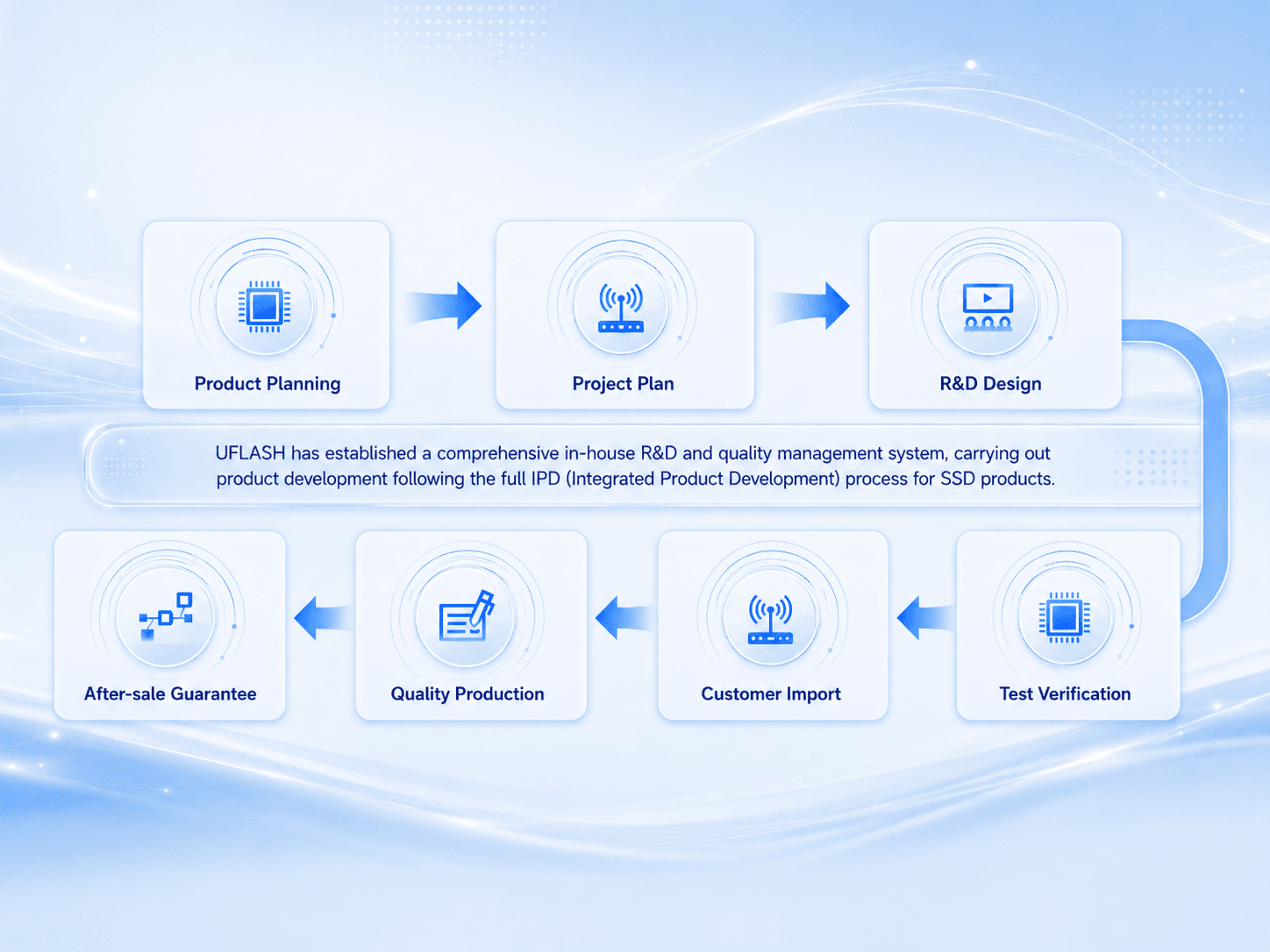
UFLASH has established a comprehensive in-house R&D and quality management system, carrying out product development following the full IPD (Integrated Product Development) process for SSD products.

Safety Certifications
Besides Chinese Mainland and existing service areas. UFLASH can also cooperate to submit for safety certification in other locations as specified by the customer.

Quality Control Standards and Management Mechanisms
Referencing T/CIE 166-2023 performance test requirements, comprehensively evaluate the performance of sequential and random read/write, latency, and IOPS.

According to the T/CIE 166-2023 standard, enterprise-level SSDs need to test sequential read and write, random IOPS, and response latency to ensure they meet performance requirements under high-load data center scenarios. The testing covers both steady-state and burst work modes.
Use standardized tools such as FIO to simulate real workloads, measuring 4KB random read/write IOPS and large file sequential throughput. Combine QoS metrics to assess the latency predictability of 99.999% of requests, ensuring SLA compliance.
Conduct continuous read and write workload tests in high and low temperature environments to verify the performance stability of the SSD when starting at high temperatures of 70°C or at low temperatures, simulating extreme operating conditions in a data center.
Quantify test data through a performance scoring system and conduct horizontal evaluation by comparing it with industry benchmark values. The results are used to optimize firmware scheduling strategies and hardware design, improving overall service quality.
Combine JEDEC durability test standards to quantify TBW and DWPD indicators to verify stability under long-term load
Standards such as JESD219A formulated by JEDEC provide a unified basis for enterprise SSD endurance testing, clarifying the test methods and environmental conditions for TBW and DWPD, ensuring comparability between products from different manufacturers.
Total Bytes Written (TBW) reflects the cumulative amount of writing an SSD can endure over its lifecycle. It is tested based on actual enterprise workloads and is an important parameter for evaluating long-term stability.
Daily Write Per Day (DWPD) indicates the number of times an SSD can be completely written to its capacity each day. A high DWPD value reflects the product's excellent durability in high-intensity writing scenarios.
By simulating typical read and write patterns and temperature cycles in data centers, verify the SSD's ability to maintain performance under continuous high load and the reliability of data retention, thereby improving the stability of actual deployment.